

Recently, AJ Yuan from Los Altos High Freestyle Academy, who is a student, SVBE Volunteer and cycling enthusiast, documented SVBE for their school project. Thank you, AJ, for the effort you put into writing the featured article below!
Punctured tires, rusted chains, misaligned brake calipers, out-of-true wheels, bent derailleurs—awesome. I’m greeted by several rows of refurbished bikes ready for sale or donation. Shelves and carts filled with supplies line the walls of the warehouse. Repair stations and well-used bicycles fill the interior. Volunteers intermingle with each other, using tire pumps, lube, housing cutters, spoke wrenches, hex wrenches, equipment of all sizes, shapes, and models, collaborating as a community.
The Silicon Valley Bicycle Exchange, known as BikeX or SVBE, is a non-profit located in the heart of Silicon Valley. In an area where gas costs $6 a gallon, where jobs keep people behind desks all day with little exercise, and where a pressured life is the standard, therein lies a place for those yearning to improve their community. On the outskirts of Palo Alto, the SVBE fulfills these desires by making bikes more accessible. People with a wide range of experience, whether they love biking, love problem-solving, or just want to give back, help sustain an affordable mode of transportation.
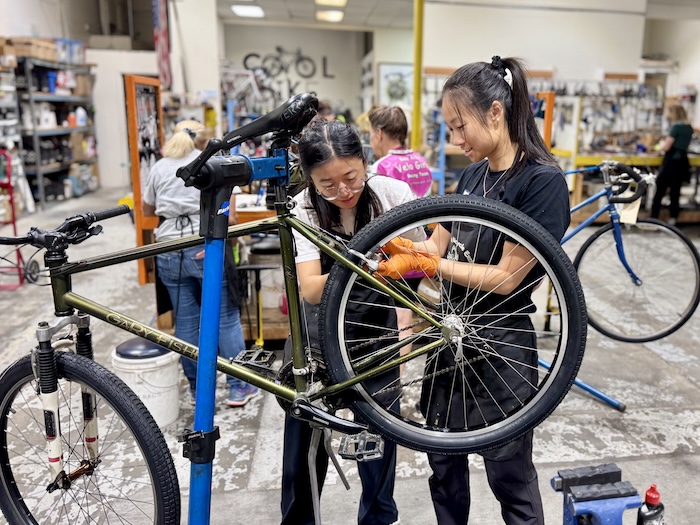
“There’s a lot of stuff to learn, and there’s a lot of wonderful people to co-mingle with and learn from, so it's just really a special place,” says mechanic Shirley Weathers. Shirley has been volunteering at the Exchange for two years now after first hearing about the organization, and recalls her first day: “...so it was like ‘boy that’s really what I want to do.’ So I signed up just like everybody does their first time on Eventbrite. And I came and this wonderful guy who is not here today but he still volunteers, he’s here almost all the time, and he was my mentor for the day, did a fabulous job of walking me through doing all of these things. And I was just helped.” Shirley has been coming in twice a week ever since.
Most new volunteer mechanics are paired with mentor mechanics, who supervise the mechanics or “apprentices” and help them perform the needed repair work. “There’s a lot of camaraderie,” says Jay, a volunteer mechanic. “There are some people who are very, very skilled. And it’s a lovely service. It really does fill a need.” According to the SVBE 2025 annual report, the Exchange has racked up a cumulative 111,000 volunteer hours, working to redistribute over 13,000 bikes total to local communities.
The origins of the Exchange date back to 1993, as described in SVBE’s “History” page. It was founded under the Mountain View Community Services agency, an organization that offers services to those on low and fixed incomes. “We used to be in a tiny, tiny, tiny little shed in the back of an auto repair shop,” SVBE founder Dave Fork recalls. Dave can often be found working on bikes, like any other volunteer. To him, the SVBE has always been a longtime passion project: “It goes back to my childhood roots when I repaired my first bicycle, and I had so much fun doing it, I wanted to make sure that youth, especially, would have the experience that I had and the setting that I did not have. There was no community bike shop where I grew up.”
Over the years, the Exchange has grown steadily, eventually getting official non-profit status in 2013. In 2019, it moved to the warehouse at 3961E Bayshore Road, sponsored by Google, which remains its current location. Today, finalizing a long-term relocation or permanent housing plan remains a goal, which comes with many challenges. According to SVBE Director of Programs, Kelly Boyett, purchasing the warehouse would cost the Exchange upwards of $5 million, and due to the organization's status as a non-profit, a long-term lease would need to be a lot cheaper than one for most other organizations, which not many are willing to provide in an area like Silicon Valley.
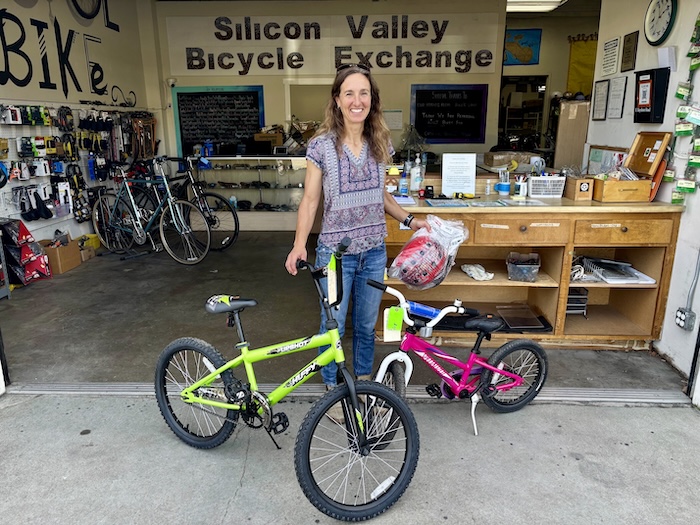 Despite this, the non-profit status remains a source of pride for the Exchange: “Any non-profit that you work with, there’s always something for everyone, whether you’re in need of something or you’re looking to volunteer your time or give away your money,” says Kelly. “It’s a very community-based thing.” Kelly also notes that the reason why people are more likely to volunteer at non-profits is due to the satisfaction of knowing their efforts are directly helping their community, in contrast to for-profit organizations, which often prioritize income and shareholder value. However, no matter what the goal of an organization or corporation is, an increased use of the bike has its tailored benefits.
For example, according to the Victoria Transport Policy Institute, an independent organization focused on solving transportation problems, parking spaces for cars in the region can cost anywhere between $20,000 and upwards of $80,000, which indirectly pays for worsening climate problems. In the broader Bay Area, transportation accounts for 40% of all greenhouse gas emissions, according to the Bay Area Economic Institute. Just a single car trip done by a bicycle a day instead reduces the average person’s annual carbon emissions by 67%, as reported by a 2022 UCLA transportation study. In response, a leading goal of SVBE is to help with long-term sustainability.
In addition to directly benefiting the community, Bicycle refurbishment also extends to the natural environment. With the added support of donating over 4500 helmets, locks, and lights, according to the annual report, the Exchange diverted approximately 23 tons worth of material from landfills in 2025 alone. Rather than living out the rest of their life in a dump, bicycles sent to SVBE begin a whole new journey.
They first enter the Exchange strictly through donors, most commonly booked online through the SVBE website. Most are gladly accepted, save for cheap department store bikes, which are “designed to roll past the cash register in the big box store,” jokes Dave. A 22-point checklist will then be attached to each of them that has everything the bike needs to go through, starting with the general inspection of the frame and ending with a test ride. Once they’re all refurbished, they go through two levels of QA (quality assurance) testing to make sure they’re safe and rideable. After that, the bikes are divided into two categories. The higher-end ones typically get marked with a blue tag for retail, which directly funds operating costs, and supports the organization’s status as a non-profit. The rest are marked with a green or white tag and sent to a wide variety of social service organizations. “Underhoused people, socio-economically disadvantaged families, veterans, immigrant farm-workers, foster youth, people who don’t have the luxuries of the majority of people who live in such an affluent area here and who our community often overlooks," says Kelly. “They’re the ones who need our transportation, more than the rest of us.” This is easily seen through the SV’s wealth disparity. According to the 2026 Silicon Valley Index, published by Joint Venture Silicon Valley, a regional collaboration group, the top 10% of SV households own 75% of the region's entire wealth, while the bottom half only own 1%. This means that for some, purchasing and maintaining a car is far beyond reach, a vehicle the region was built around commuting with. One of the many partner organizations of SVBE is Silicon Valley Bicycle Coalition, a former parent organization, which primarily advocates for cycling needs and infrastructure.
Dating back to her childhood roots in Las Vegas, Kelly has been volunteering and working with non-profits, and has now been a part of the Exchange for over a year and a half. A favorite of hers is the annual volunteer celebrations, which consist of a morning shop cleanup and then a potluck. “It’s a really nice special celebratory day,” she says. “A lot of the folks who come here, they’ll come on a weekly basis and it’s easy to not be looped into the larger impact of what you’re doing.” The event celebrates and reflects on the accomplishments of the past year and looks into future goals, bringing together volunteers and reminding them why they keep coming back. Other events currently held by the Exchange include swap meets, women’s and co-ed nights, bring your own bike days, Veterans repair days, and many more.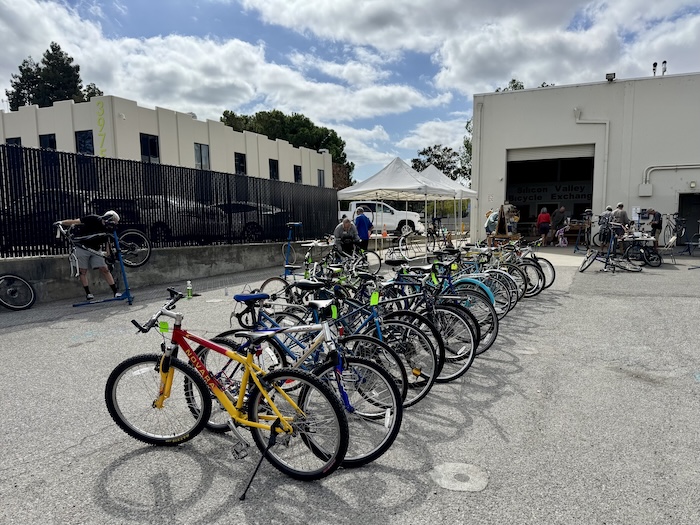
Beyond experienced mechanics, the Exchange seeks to attract community members of all abilities who are willing to jump in. Two new volunteers, Ramin and Sunny, started after Ramin heard about the Exchange through a work colleague. It is now their second time volunteering. “I feel like I can take my experience here and put it into my own life,” says Sunny, a Mountain View High student. In the past, Sunny has enjoyed riding Shoreline trails, known well for birdwatching and scenic views of the bay, a favorite among cyclists and hikers in the Bay Area. Nowadays, he mostly spends time on his bike riding to school. “Getting a flat, I know how to fix it now, and everything’s become a little simpler. And I can obviously help my friends because sometimes we bike together,” he says. The SVBE also draws student volunteers through school projects and community service hours, with 41 youth volunteer events taking place in 2025.
With a strong circle of volunteers, the Exchange eagerly rides on into the future, focused on and beyond the warehouse. Laid out in the SVBE 2026 plan, it’s now partnered with the cities of South San Francisco and Palo Alto, and is looking to host more off-site repair events at local schools and improve overall volunteering experience and outreach. “If you’re someone who likes puzzles, you would love working on a bike and getting your hands dirty, and you know that you’re doing it for a good cause,” says Kelly.
“Together, we’re setting the foundation for an even bigger impact in the years ahead.” -SVBE Annual Report.
AJ's email is
